
Lukas Bergmann, Senior Health and Science Editor.
You are standing at the bathroom mirror in the sort of light no shop ever has, holding a bottle that looked perfect under the shop’s spotlights and now sits grey against your jaw. Somewhere in the cabinet behind you are three more bottles in various states of half-use, each bought on the promise that this one would finally match. It is one of the most returned categories in beauty, and not because women cannot choose colours. Foundation shade-matching fails for a specific, fixable reason: most of us test it on the back of the hand, where the skin tone and texture are nothing like the face. Once you know what the product is actually doing on your skin, and which claims on the box are marketing rather than mechanism, the guesswork mostly disappears.
- Match on the jaw in daylight, never on the hand: hand skin is thicker and often a shade darker or more yellow than the face, which is the single biggest cause of visible foundation lines.
- Coverage and finish are governed by pigment load and film-forming polymers, not by price: a modestly priced formula can sit as well as an expensive one if the ratios are right for your skin.
- Oxidation is real but predictable: most liquid foundations shift slightly warmer within 20 to 30 minutes of application, so testing patience matters more than testing quantity.
Why The Back Of Your Hand Lies To You
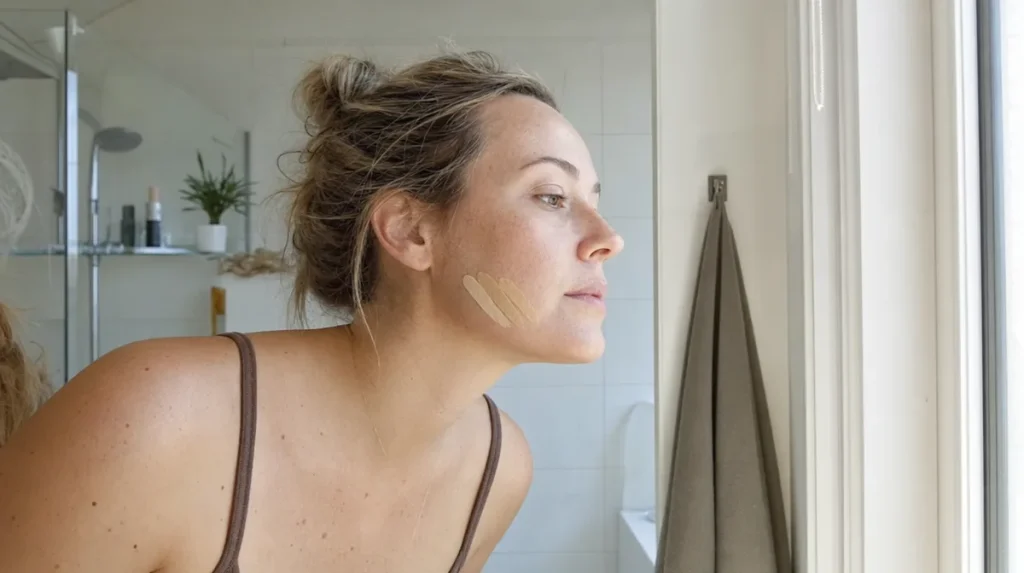
Skin tone is not uniform across the body. The jaw and neck are usually a shade or two lighter than the hands, which see more sun exposure and have thicker, less reflective skin. Testing a foundation on the wrist is a bit like choosing paint for your living room walls by looking at a swatch under the shop’s fluorescent tubes: the colour you see is not the colour you will live with.
The better method is simple. Apply three vertical stripes along the jawline, blending the edges only slightly, then walk to a window or step outside. Daylight, even on an overcast day, is the only light that will not flatter or distort the undertone. The stripe that seems to vanish into the skin, rather than sitting as a distinct band, is the match.
Most people test in artificial light because that is where the mirror lives, and most complaints about foundation looking orange or ashy trace back to exactly this mismatch between test light and daylight. It costs nothing to walk to a window before buying.
Undertone Versus Depth: Two Different Questions
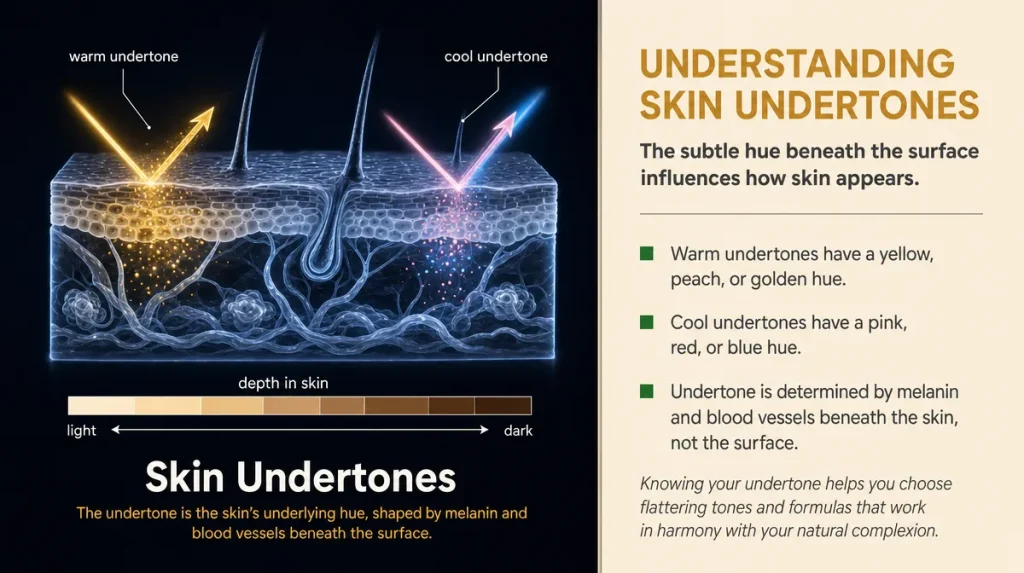
Shoppers often conflate two separate variables. Depth is how light or dark the skin is. Undertone is the underlying cast, generally described as warm (yellow or golden), cool (pink or red), or neutral (a balance of both). A foundation can be the right depth and the wrong undertone, and that mismatch is what produces the grey or orange cast people describe.
A rough household comparison: think of depth as the volume dial on a radio and undertone as the station itself. Getting the volume right does not help if you are tuned to the wrong frequency.
A simple self-test: look at the veins on the inside of your wrist in natural light. Green-toned veins tend to suggest a warmer undertone; blue or purple-toned veins tend to suggest a cooler one. It is not a laboratory-grade method, but dermatologists commonly cite it as a reasonable starting point, and it takes seconds to try before you ever pick up a bottle.
What Coverage Actually Means, Chemically
Coverage is not a marketing adjective, it is a measurable property of how much pigment (usually iron oxides and titanium dioxide) sits in the formula, and how those pigments are dispersed through the base. A higher pigment load gives more opacity, which is what people mean by full coverage. A lower load, spread through more emollient or water carrier, gives a sheer finish that lets more of the natural skin show through.
A 2021 study in the International Journal of Cosmetic Science measured pigment particle size and dispersion uniformity across a range of commercial foundations and found that coverage perception correlated more strongly with even particle distribution than with total pigment percentage. In plain terms: a well-milled formula with less pigment can look more covering than a poorly dispersed one with more.
This matters because coverage is often used as a proxy for quality, when it is really a proxy for a specific chemical choice that suits some skins and not others. Someone with visible redness may want higher coverage; someone with mostly even tone but some texture may find a full-coverage formula settles into fine lines and looks heavier than intended.
Finish: Why Matte, Dewy And Satin Behave So Differently
Finish is decided largely by the ratio of oils to film-forming polymers and silicones in the formula. Matte finishes typically rely on more silica or starch-based powders that absorb oil on the skin’s surface, which is why they can look flat or accentuate dry patches on skin that lacks surface moisture. Dewy finishes usually contain more humectants and light oils, which reflect more light, but on very oily skin this can read as shine rather than glow within a few hours.
A useful household analogy: think of matte finish as blotting paper laid over the face, and dewy finish as a very thin film of oil. Neither is better; each suits a different surface.
The mistake most people make is choosing a finish based on how it looks in the bottle or on a model, rather than on how their own skin behaves through the day. Someone with a combination skin type, oily through the T-zone and dry at the cheeks, may need to accept that no single finish will behave identically across the whole face, and that setting powder only in the T-zone is a reasonable, common workaround.
Where Inexpensive Formulas Actually Cut Corners
Cheaper does not automatically mean worse, but there are verifiable places where lower-cost formulations often compromise. One is pigment quality: cosmetic-grade iron oxides vary in how finely they are milled, and coarser pigment can look patchy or sit unevenly in pores. Another is emulsion stability, the science of keeping oil and water phases blended over time; a poorly stabilised emulsion can separate in the bottle after a few months, requiring more shaking and giving inconsistent coverage bottle to bottle.
A further area is the preservative and emollient system, which affects how the product wears through a humid afternoon or a heated room in winter. Cosmetic chemists writing in IFSCC congress papers have noted that emulsion stability testing under temperature cycling is one of the more expensive parts of formulation research, and it is sometimes the first thing trimmed in a lower-cost product.
None of this means an affordable foundation cannot perform well. It means the corners that get cut are specific and checkable, rather than a vague sense that price equals quality.
Reading The Label Without A Chemistry Degree
Ingredient lists on foundations are ordered by concentration, so the first five or six entries after water tell you most of what matters. Look for where oils and emollients sit relative to silicones (ingredients ending in -one or -oxane, such as dimethicone); a formula with silicones high on the list and oils lower down tends toward a smoother, more blurring finish.
Words like “anti-ageing” or “skin-loving” on the front of the bottle are marketing language, not ingredient claims, and Cosmetics Europe’s general guidance on cosmetic labelling notes that such descriptive terms are not independently regulated in the way active percentages are. That is worth knowing before paying a premium for a word rather than a compound.
SPF inclusion is worth checking separately. A foundation listing SPF 15 or SPF 20 is not a substitute for a dedicated SPF 30 or SPF 50 sunscreen worn underneath, particularly for readers in southern Europe where UV exposure runs high for most of the year; the amount of foundation most people apply is far below the amount used in SPF testing, so the labelled factor is rarely achieved in practice.
Patch Testing And The 24-Hour Wear Check
A patch test remains the simplest safeguard against irritation, and dermatologists commonly recommend applying a small amount behind the ear or on the inner forearm and waiting 24 to 48 hours before applying to the face, particularly for anyone with a history of sensitive skin or eczema. Reactions to foundation are more often linked to fragrance or preservative systems than to pigments themselves.
For judging wear, a fair test runs through a full day, not an hour in the shop. Apply in the morning, note how the finish looks at midday under office lighting or daylight, and check again in the evening. A formula that looks good at 9 a.m. and patchy by 6 p.m. is telling you something about how it interacts with your skin’s own oil production, not about the product being faulty.
A European academy of dermatology has previously advised, in general public guidance on cosmetic safety, that patch testing is worthwhile even for products marketed as hypoallergenic, since that term is descriptive rather than a guarantee.
Sampling Before Committing To A Full Bottle
Many counters in perfumeries and department stores will decant a small sample on request, and this remains the most reliable way to test a foundation through an actual day, including a commute, a warm office, and an evening. Buying a full bottle based on a five-minute in-store application is one of the more common ways money is wasted in this category.
Seasonal changes are worth factoring in too. Central heating through northern European winters can dry out formulas that felt fine in a milder season, while a formula that wore beautifully in a Mediterranean summer may feel heavy once the weather cools. Reassessing your foundation once or twice a year, rather than assuming one bottle suits every month, is a habit worth building.
Key Takeaways
Match shade on the jaw in daylight, not on the hand indoors.
Separate depth from undertone: they are two different decisions.
Coverage depends on pigment dispersion, not price; finish depends on the oil-to-polymer ratio.
Check ingredient order for silicones versus oils, and treat marketing words on the front of the box separately from the actual formula.
Patch test new products, and judge wear over a full day rather than an hour.
A Quick Checklist Before You Buy
- Test three stripes on the jaw and check them in daylight, not under shop lighting
- Identify undertone separately from depth using the wrist-vein method as a starting point
- Ask for a sample rather than buying a full bottle on a first try
- Check the ingredient list for silicone-to-oil ratio if you want a smoother finish
- Patch test behind the ear 24 to 48 hours before applying to the face
- Wear the sample through a full day, including evening, before deciding
- If SPF matters to you, treat the foundation’s factor as a bonus, not your main protection
This article is for general information only and does not replace individual advice from a dermatologist or pharmacist.
Results and skin reactions vary from person to person; patch testing is recommended before regular use.