
Marta Kowalska, Staff Writer.
There is a drawer in most bathrooms that nobody likes to open. Six or seven handles stick out at odd angles, bristles splayed, one or two crusted stiff at the base where foundation dried in and never came out. You reach for the softest-looking one anyway, because the others have started shedding onto your cheekbones, and you wonder, not for the first time, whether a better set would have saved you the money you spent on three bad ones.
That question is more answerable than it looks. Specialists who evaluate makeup brushes do not start with the price tag or the packaging. They start with the fibre, because a single useful fact decides most of what a brush can and cannot do: synthetic fibres now outperform natural hair for almost every liquid, cream and gel product on the market, a shift in professional preference that has happened quietly over the past decade. Knowing why changes how you shop.
This guide walks through what a trained eye checks first, in the order it checks it, so that the next drawer you build is one you actually want to open.
- Fibre type decides function more than price does: synthetic bristles suit liquid and cream formulas, natural hair suits loose powder, and a set mixing both intelligently is doing something deliberate rather than cutting corners.
- The ferrule, not the handle, is where cheap sets fail first: a loose or poorly sealed metal band is the earliest sign of a brush that will shed within weeks.
- A thirty-second water test at home tells you more than any marketing claim: how a brush behaves wet predicts how it will behave for the next two years.
Why The Fibre Matters More Than The Brand Name
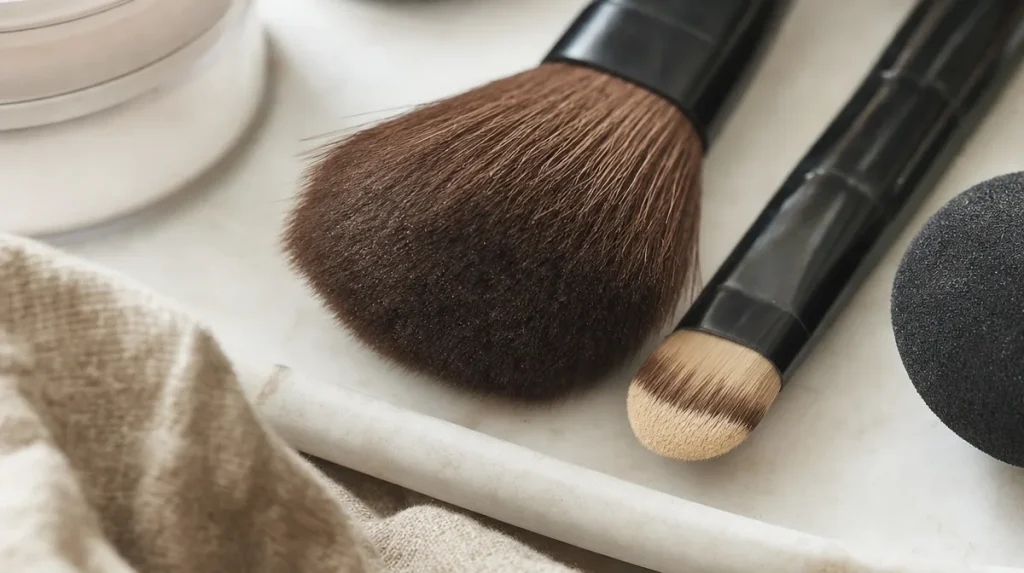
Hold two brushes side by side, one with hair that looks slightly glossy and uniform, one with hair that looks a little duller and more varied in length. The first is very likely synthetic, the second natural.
Synthetic fibres, usually a nylon or taklon blend, are solid rather than porous. Think of them like a laminated paintbrush: liquid sits on the surface rather than soaking in, so foundation and concealer glide on without the brush drinking half the product before it reaches your skin. Natural hair, by contrast, has a cuticle structure that holds and releases fine, dry powder particles gradually, which is exactly what you want for a soft wash of blusher or bronzer.
A 2021 study in the International Journal of Cosmetic Science comparing fibre absorption rates found synthetic bristles retained up to 60 per cent less liquid product than natural hair of comparable density, which is why professional make-up artists increasingly reach for synthetic brushes even for cream contour and liquid blush.
The mistake most buyers make is assuming natural hair is automatically the premium, better option because it costs more to source. It is not better, it is suited to a narrower job. A good set mixes the two deliberately: synthetic heads for base and liquid products, natural or natural-blend heads for powder finishing. If every brush in a set has identical-looking bristles, that is usually a sign the set was built to a budget rather than to a brief, not a sign of quality.
Reading A Brush Shape Before You Buy
Shape tells you what a brush is for faster than any label does. A dense, flat top pressed into foundation and swept across the back of the hand should leave a smooth, even layer with no visible streak lines, that is a base brush doing its job. A tapered, fluffy head that narrows to a rounded point is built for blending along the crease of the eye or softening the edge of blusher, precisely because it cannot deposit a hard line even if you try.
The mistake is judging a brush by how full it looks in the hand. A large, round head photographs well but is often too blunt for precision work like concealer under the eye or eyeliner along the lash line. Specialists check whether the shape narrows where it needs to narrow and flattens where it needs to flatten, not whether it looks generous.
Try this while reading: picture the last three places on your face where make-up looked patchy by midday. Patchiness around the nose usually means the brush used there was too domed to reach into the crease beside it. Chalky lines along the jaw usually mean a blending brush was too sparse rather than too small. Shape explains most of the complaints people wrongly blame on the formula.
The Ferrule Test: Where Cheap Sets Fail First
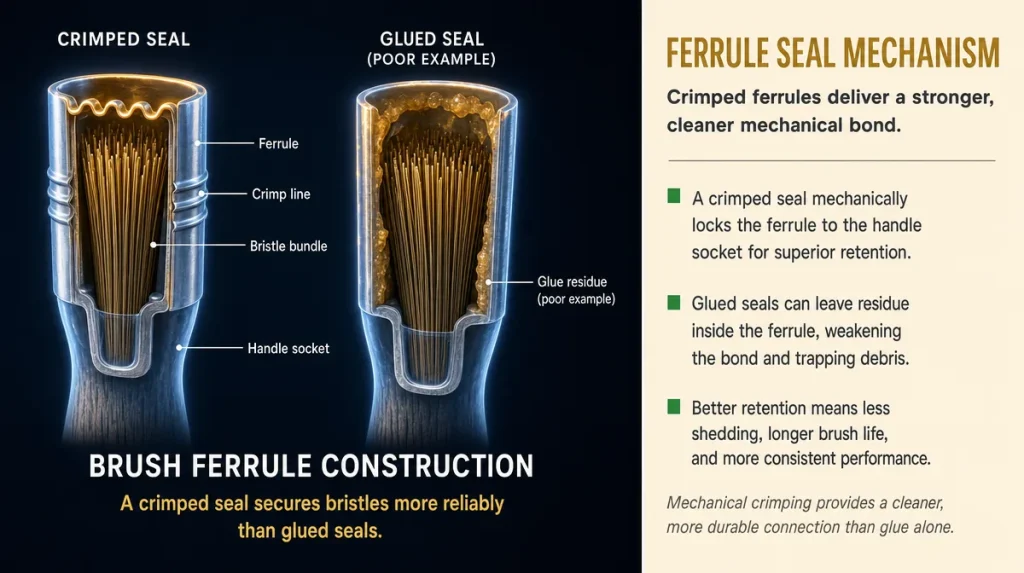
The ferrule is the small metal band that grips the bristles to the handle, and it is the single most reliable predictor of how long a brush will last. Specialists check it before they check anything else, because it fails before the bristles do.
Press gently where the ferrule meets the handle. There should be no movement, no gap, and no visible glue residue. A well-made ferrule is crimped and sealed in one continuous motion; a poorly made one is glued on afterwards, and glue degrades with water exposure far faster than metal crimping does.
Think of it like the base of a broom head: if the bristles are simply glued into a socket rather than bound and sealed, the first few washes will loosen them, and within a few weeks you will find bristles coming away in your palm rather than on your face.
Cheap sets cut this corner because a secure, seamless ferrule requires more manufacturing steps than a quick glue-set does, and it is the part a customer is least likely to examine before buying. A 2019 Euroconsumers lab comparison of budget and mid-range brush sets across several European markets found shedding complaints concentrated almost entirely in sets with visibly glued, unsealed ferrules, rather than in any particular fibre type.
Handle Weight And The Five-second Balance Check
Pick up a brush and hold it loosely between thumb and forefinger, the way you would hold a pencil you are not yet writing with. A well-balanced brush sits roughly level, tipping neither sharply toward the bristle end nor the base. A poorly balanced one feels top-heavy or handle-heavy within seconds, and that imbalance is exactly what makes your hand tire and your line wobble during detailed work like eyeliner or brow filling.
Handles are usually wood, resin or a lightweight metal alloy. None of these is inherently better; what matters is whether the weight is distributed to suit the brush’s job. A long-handled powder brush can afford to be a little heavier because it is used in broad, confident strokes. A short-handled precision brush needs to be light enough for small, controlled movements near the eye.
The mistake buyers make is treating a heavy handle as a sign of quality, because it feels substantial in the hand at the counter. Weight is not value. A set with mismatched, overly heavy handles on its smallest brushes is usually prioritising a satisfying unboxing moment over daily usability.
How Density Changes What A Brush Can Actually Do
Density, how tightly the bristles are packed, decides whether a brush builds colour or sheers it out, and it matters more than bristle count claims printed on packaging.
A densely packed brush picks up and deposits more pigment in one stroke, which suits full-coverage foundation or bold eyeshadow. A loosely packed, airy brush picks up less and diffuses what it does pick up, which is exactly why highlighter and setting powder brushes are almost always built looser. Confusing the two is the most common application mistake: a dense brush used for highlighter tends to lay colour down in a hard, unblendable patch, not because the product is wrong but because the tool was.
A simple self-test: fan a brush head out gently with your thumb. If you can see daylight through the bristles in several places, it is a diffusing brush, suited to powder and blending. If the head stays solid and opaque when fanned, it is a building brush, suited to base and precise colour. Running this check on a set before buying, even through its original packaging where the shape is visible, tells you more about intended use than any description on the box.
The Shedding Test You Can Run At Home
Wet the bristle tips of one brush from a set under lukewarm water and gently squeeze the excess out between a folded tissue, the way you would blot a paintbrush. Count how many fibres transfer to the tissue. One or two loose fibres on a first wash is normal settling and nothing to worry about. Five or more, or any fibre that pulls free with a visible root rather than a clean break, suggests a ferrule or bonding problem that will worsen with use.
Repeat the same gentle squeeze a second time after the brush has air-dried flat for a few hours. A brush that continues shedding on a second handling, rather than settling after the first wash, is unlikely to improve with time.
This thirty-second check matters because shedding is rarely cosmetic. Loose fibres on the face are a minor irritant for most people, but for anyone with reactive or sensitised skin, repeated fibre contact near the eyes can contribute to irritation, which is one reason the European Academy of Dermatology and Venereology includes brush hygiene and fibre shedding in its general public guidance on cosmetic tool care. None of this requires a laboratory. It requires lukewarm water, a tissue, and five minutes before you decide a set is worth keeping.
Cleaning Habits That Decide How Long A Set Lasts
Even a well-made set shortens its own life through poor cleaning, and the mistakes are almost always the same three.
The first is using water that is too hot. Heat softens the glue and crimping inside the ferrule over repeated washes, which is the mechanism behind brushes that suddenly start shedding after months of fine performance. Lukewarm water only, every time.
The second is letting a brush dry standing upright, bristles pointing up, in a cup. Water travels down into the ferrule by gravity and sits there, which is precisely what loosens the bond from the inside. Drying flat, or tipped slightly downward over the edge of a counter with a folded towel beneath, keeps water away from the glue line.
The third is skipping cleaning altogether for weeks at a time. Cosmetics Europe’s general consumer guidance on cosmetic tool hygiene recommends cleaning brushes used with liquid or cream products roughly every one to two weeks, and powder brushes monthly, precisely because product residue left to dry repeatedly in the bristles becomes harder to remove and gradually stiffens fibres that were originally soft. A brush that feels scratchy after six months has usually been under-cleaned, not poorly made.
What Is Marketing And What Actually Matters
Packaging language does a great deal of work that fibre and ferrule construction should be doing instead. A few terms are worth reading sceptically rather than taking as settled fact.
“Vegan fibres” describes a sourcing choice, not a performance guarantee; it almost always means synthetic, which is useful information, but it says nothing about ferrule quality or density. “Ultra-soft” is a texture claim, not a function claim, and an ultra-soft brush can still be the wrong shape for the job. Bristle counts printed on boxes are rarely independently verified and vary enormously in how they are measured, so they are not a reliable basis for comparison between sets.
What consistently does matter, based on everything above: fibre type matched to product category, a sealed rather than glued ferrule, a shape that narrows or flattens appropriately, and a cleaning routine that respects the glue line. Editorial coverage in titles like ELLE and British Vogue tends to describe sets in exactly these practical terms, texture, shape, how a brush performs after repeated washing, rather than by bristle count or branding, which is a reasonable model to follow when you are standing in front of a shelf trying to decide.
Key Takeaways
A good makeup brush set is decided by four things, in this order: fibre matched to product type, a sealed ferrule rather than a glued one, a shape suited to the job it claims to do, and a cleaning routine that keeps water out of the glue line. Price and packaging tell you very little on their own; a thirty-second water test at home tells you far more than any claim on a box.
A Quick Checklist Before You Buy
- Check whether bristles are synthetic (for liquid and cream) or natural (for loose powder), and whether the set mixes them deliberately.
- Press the ferrule gently: no movement, no visible glue, no gap.
- Fan the bristles: dense and opaque for building colour, airy and see-through for diffusing.
- Picture the shape doing its specific job, not how full it looks in the hand.
- Once home, run the wet-tissue shedding test before relying on any new brush for a full face of make-up.
- Clean with lukewarm water only, and dry flat or tipped downward, never bristles-up in a cup.
This article is for general information and does not replace individual professional advice.
Results and experiences with any tool or technique described here may vary from person to person.