
Charlotte Hayes, Beauty Editor.
You are standing in front of the bathroom shelf, three half-used bottles of eau de parfum lined up next to each other, and none of them smell now the way they did in the shop. One faded within the hour. One turned oddly sour by evening. One you loved on the tester card but barely recognise on your own wrist. The question you actually want answered is not “which perfume is best” but “how do I stop this happening again”.
Here is the useful fact most buyers never hear: a fragrance is not one fixed scent, it is a chemical reaction between the formula and your own skin, and specialists judge it accordingly, not by sniffing a paper strip for ten seconds. Once you know what they actually check, in what order, a counter visit stops being guesswork.
- Concentration on the label is a starting clue, not a guarantee: an eau de parfum has more aromatic compound than an eau de toilette, but how it behaves on you depends on your own skin chemistry as much as the percentage on the box.
- The first ten minutes lie: the top notes you smell off a tester strip evaporate fastest and rarely resemble how the fragrance settles over the following hours on warm skin.
- Consistency, not intensity, is the real quality marker: a well-made fragrance smells recognisably itself from the first spray to the last hour, batch after batch, rather than simply smelling loud.
Reading The Concentration Label Properly
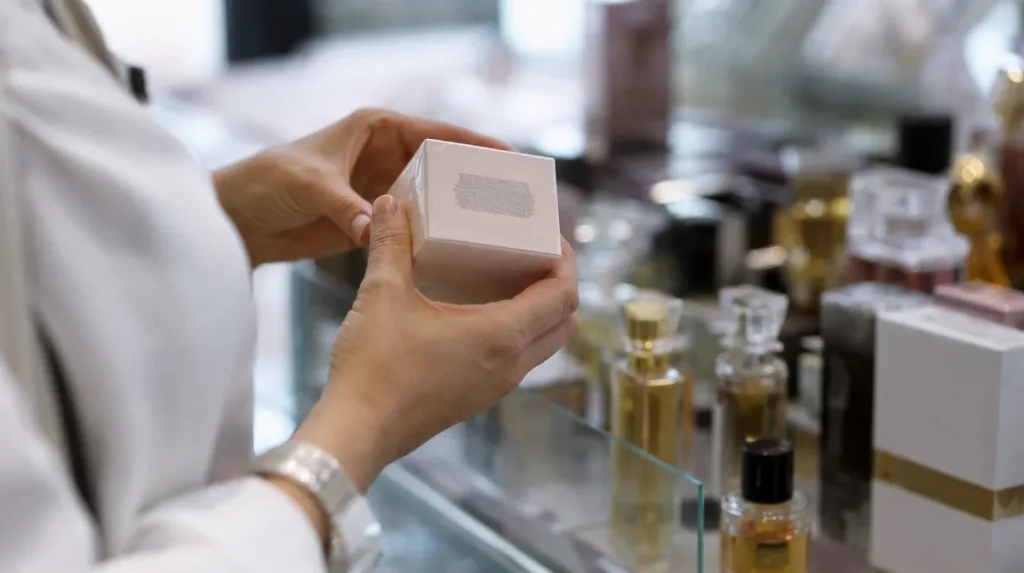
Every bottle carries a word most people skim past: parfum, eau de parfum, eau de toilette, eau de cologne. These describe the ratio of aromatic compound to alcohol and water, roughly from richest to lightest. It is a bit like squash concentrate: the same fruit base, diluted to different strengths, tastes stronger or weaker but is not automatically better at either end.
A higher concentration usually means the scent lasts longer and projects a little further, but it also means the raw materials are more exposed, so any weakness in the formula shows up more clearly. Buyers often assume “eau de parfum” is simply the superior version of a scent they know as an eau de toilette. Sometimes the two are formulated quite differently, not just diluted differently, so comparing them by nose rather than by label is the safer habit.
Self-test: before you spray anything, read the front and back of the box. Note the exact wording, and check whether the batch code (usually a short string of letters and numbers near the barcode) is visible and not scratched off, since a missing or damaged code is one of the simplest ways to spot stock that has been repackaged or is far older than it looks.
Why The Same Scent Smells Different On Two People
Skin is not a neutral surface, it is an active one. Its natural oils, its pH, even recent diet and certain medications can shift how aromatic molecules evaporate and combine. A 2021 study in the International Journal of Cosmetic Science found that skin surface lipid levels measurably altered the perceived intensity and character of the same fragrance applied to different volunteers, which is one reason a scent that smells sweet on a friend can smell drier and woodier on you.
Think of it like cooking the same recipe on two different stoves: one runs hotter, one runs cooler, and the dish comes out slightly different even though nothing in the method changed. Dry skin tends to hold fragrance less well and can make it fade faster; oilier skin often amplifies base notes and extends wear.
This is why a specialist never judges a fragrance from someone else’s arm, and why buying a scent purely because it suited a friend or an influencer is one of the more reliable ways to be disappointed. If you can, test on your own pulse points, not the back of your hand, since wrist and neck skin runs slightly warmer and gives a more honest reading of how the scent will actually wear.
Testing On Skin, Not On Paper
Paper strips exist for a reason: they let a specialist compare formulas quickly without a queue of committed testers. But paper has no oils, no warmth, no pH, so it only ever tells you what the fragrance itself smells like, never how it will behave on you.
The proper method is slower. Spray once on a clean, unperfumed wrist or the inside of an elbow, then wait. The first few minutes are dominated by top notes, which are chosen specifically because they are light and evaporate fast enough to make a strong first impression. Judging a fragrance at this stage is like judging a film from its opening titles.
The honest picture only appears after thirty minutes to an hour, once the top notes have burned off and the heart notes take over, and again after several hours, once the base notes are what remains on the skin. A specialist evaluating a new fragrance will typically check it at three points across a day: on application, at the two-hour mark, and again after six hours or more.
A simple mistake to avoid: never test more than two or three fragrances in one visit. Your nose adapts quickly, a phenomenon called olfactory fatigue, and by the fourth or fifth spray everything starts to smell vaguely similar. If you must test more, step outside for fresh air, or smell your own skin, between each one.
Following The Pyramid: Top, Heart And Base
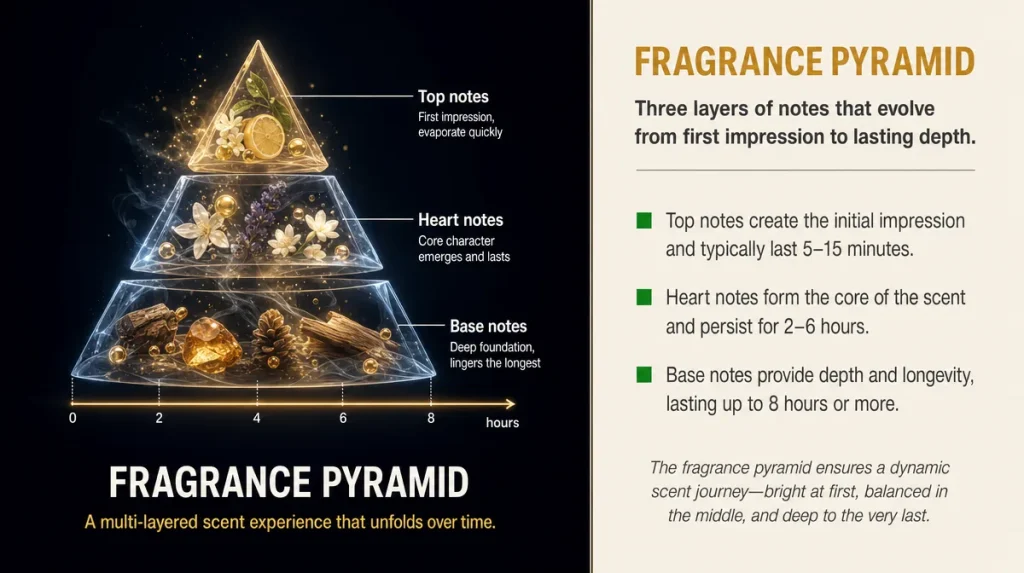
Most fragrances are built in three layers, often called the pyramid: top notes, heart (or middle) notes, and base notes. It works a little like a piece of music, with an opening phrase that grabs attention, a refrain that carries the main theme, and a bassline that lingers under everything and is the last thing you notice as it fades.
Top notes are usually citrus, light florals or aromatic herbs, chosen to evaporate within the first fifteen to thirty minutes. Heart notes, often richer florals, spices or fruit, emerge as the top fades and typically define the character most people associate with the fragrance. Base notes, commonly woods, musks, resins or vanilla, are heavier molecules that evaporate slowly and can still be present on skin or fabric after eight hours or more.
Specialists judge a fragrance’s construction by how smoothly one layer hands over to the next. A well-blended composition should not have an obvious gap where the top note vanishes and the heart has not yet arrived, sometimes described as the scent going “flat” mid-wear. Cheaper constructions sometimes show exactly this: a strong opening, a hollow middle, then a base that feels unrelated to what came before.
Self-test: spray, then check back at fifteen minutes, ninety minutes, and five hours. Ask yourself whether it still feels like the same fragrance family, or whether it has changed character entirely.
Judging Longevity And Sillage Honestly
Two words come up constantly in fragrance circles: longevity, how long a scent remains detectable on skin, and sillage, the trail it leaves in a room or as you walk past someone. Buyers often conflate strength with quality, assuming the fragrance that fills a lift is automatically the better-made one.
This is not quite right. Sillage is largely a function of molecular weight and concentration, not of craftsmanship, and a well-balanced, more discreet fragrance can be beautifully constructed while barely projecting past arm’s length. Longevity depends partly on formula and partly, as covered earlier, on your own skin.
A fair way to judge either is comparative and personal, not absolute. Apply the fragrance and check hourly, ideally without re-smelling your wrist too often, since repeated close sniffing tires the nose and makes fading feel more dramatic than it is. Ask someone else, later in the day, whether they can still smell it from a normal conversational distance. That answer tells you more about real-world sillage than any marketing description of “long-lasting” ever will.
Spotting Inconsistency Between Batches
Natural raw materials, such as essential oils from rose, jasmine or citrus, vary from harvest to harvest, much as wine varies by vintage depending on the weather that year. Reputable formulators account for this by adjusting proportions slightly to keep the finished fragrance smelling consistent, a process discussed in papers presented at International Federation of Societies of Cosmetic Chemists congresses on fragrance stability and quality control.
Inconsistency becomes a genuine quality signal when it is noticeable to the ordinary buyer, not just to a trained nose. If a fragrance you have worn for years suddenly smells thinner, sharper or simply different straight out of the box, with no change in how you store it, that is worth paying attention to.
Storage matters here too. Heat, direct sunlight and repeated temperature swings degrade fragrance faster than almost anything else, which is why a bottle kept on a sunny windowsill for a summer can smell noticeably different from one kept in a drawer. Cosmetics Europe’s general consumer guidance on fragranced product care recommends storing perfume away from direct light and heat, in the box if possible, precisely for this reason.
If you suspect a bottle has turned, compare it against a fresh tester at a counter rather than relying on memory alone. Memory for smell is notoriously unreliable over long gaps.
What Packaging And Price Actually Tell You
Heavy glass, a weighted cap, an elaborate box: these add to the cost of a fragrance, but none of them are reliable evidence of what is inside the bottle. A specialist evaluating formula quality ignores packaging almost entirely and goes straight to the liquid.
Price is a similarly imperfect guide. It reflects raw material cost to some extent, but also marketing spend, brand positioning and packaging, none of which correlate neatly with how well a fragrance is constructed or how long it will last on your skin. Comparative testing groups such as those working under the International Consumer Research and Testing consortium, whose members include several national consumer bodies familiar to European readers, have repeatedly found in published comparative work that price ranking and quality ranking of household and personal care products do not always move together.
A more useful signal than price is simply asking to see the ingredient list, which by EU regulation must appear on the packaging or be available at the point of sale. Fragrances with a shorter, more legible list of named aromatic compounds are not automatically better, but a list that is impossible to find or oddly vague is worth a second look before you buy.
A Five-minute Self-test Before You Buy
Before any purchase, a short routine saves most people from disappointment later. First, read the box: concentration, batch code, ingredient list if displayed. Second, spray once on clean skin, never on a strip alone, and walk away rather than sniffing it repeatedly. Third, come back after fifteen minutes and again after an hour, and notice whether the fragrance still feels coherent or has gone hollow in the middle.
Fourth, if buying online rather than in a shop, check that the retailer discloses the batch code or at least a recent manufacturing date, since this is your only real check against very old stock. Fifth, resist buying on the strength of the first impression alone. A fragrance that seems underwhelming in the first minute sometimes becomes the one you wear for years, once the heart and base notes settle in.
None of this requires special training. It requires patience, and a willingness to let a fragrance finish its sentence before judging it.
Key Takeaways
- Concentration on the label (parfum, eau de parfum, eau de toilette) is a starting clue, not a verdict on quality.
- Your own skin chemistry, not the tester strip, decides how a fragrance actually wears.
- Judge a fragrance across the day, not in the first ten minutes: top, heart and base notes each tell a different part of the story.
- Sillage and longevity are not the same as quality, and a quieter fragrance can be just as well made as a loud one.
- Batch consistency and correct storage matter more to how a bottle performs over time than packaging or price ever will.
A Quick Checklist For Your Next Visit
- Read the concentration wording and check for a visible, undamaged batch code.
- Spray on skin, not paper, and test no more than two or three fragrances per visit.
- Check back at fifteen minutes, ninety minutes and several hours before deciding.
- Ask a companion, later in the day, whether they can still smell it at a normal distance.
- Store any bottle you buy away from direct light and heat, ideally in its box.
This article is general information and does not recommend, test or endorse any specific product or brand.
Individual results and perception of fragrance vary from person to person, and outcomes described here may not apply in every case.